Are AI-Generated Images Taking Over Your Social Media?
If your feed seems more AI-generated than it did this time last year, it’s not just in your head. AI images, videos, captions, influencers, advertisements, and entire AI accounts are becoming common on social media. Detecting AI is only half the battle. The difficult part is deciding what to do next. Here’s a good starting point.
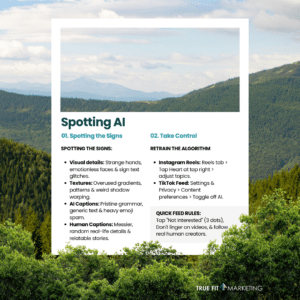
Spotting the Signs
A few social platforms, including Instagram, Facebook, and TikTok, have started labeling posts with an “AI label”. It’s important to note that this detection tech can miss a lot. You can check for these few things:
- Visual details: Strange hands or lack of human emotion, unreadable text on signs, weird shadows, overused patterns, textures, gradients, too many icons, and video glitches where things warp.
- The caption: AI writes clean posts filled with generic statements, too many emojis, and pristine grammar. Humans are usually messier, add random details, and tell actual stories that are relatable.
Taking Control
You can’t eliminate all AI from your feeds quite yet, but you can train the system to block most of it:
- Change Instagram topics: Go to the Reels tab, play a reel, and select the heart at the top right to find your algorithm controls. You can adjust what subjects you’re interested in and content you want less of.
- Control TikTok: Go to Settings and Privacy > Content preferences > Manage topics; slide the toggle left if you want to see less AI-Generated Content.
- Select “Not Interested”: Tap the three dots on an unwanted post to keep the app from showing you that kind of thing.
- Don’t Linger: If you linger on a video with curiosity, the app counts that as interest and makes it more likely you’ll see more.
- Follow Actual Creators: Connect with real people, designers, and artists.
Pros and Cons of AI for Marketing
There have been so many posts lately circulating online about the usage of AI and if it is appropriate or inappropriate in the marketing world. There are usually two schools of thought:
- AI is a tool and should be used as such
- Don’t touch AI with a 10-foot pole
The pro in using AI is that it can provide information in a matter of seconds depending on what you ask it to look up. It can also provide links to where it found the information so you, the human, can determine whether it is usable or not. AI can get writers out of a funk and help to get ideas generated, so long as those ideas aren’t just copy and pasted, and even help designers with creative gestures. And yes, AI can create you something in a matter of seconds, but here is where the cons come into play.
Is it branded properly? Does it have your colors correct? Is the font what you always use? Does the background contrast with the messaging?
A huge con of using AI is that there are usually mistakes and misinformation provided. AI isn’t perfect (and neither are humans) but at least a human can notice when a location address is missing, a time is wrong, a person has 7 fingers, or that there is just too much going on with the flyer that the important information is getting lost.
And a growing con of using AI is the mistrust aligned with the use of it. No matter if the information is accurate or not, if people are seeing a business using AI for their flyers or social graphics, they are usually getting “scolded” and their brand could be harmed.
These are all things that humans consider when creating a flyer or social media graphic. Humans make sure all of the information provided is accurate, the colors are truly your brand’s colors, the font is approved, and so on.
The Bottom Line
Designers and writers are fighting a digital revolution when it comes to AI. Who will eventually win? Only time will tell. AI is a good tool to use, but it is a tool. A hammer can’t do all of the work without the human swinging it.